
The Problem
Counterfeit: The Brand Owners’ Problem
Successful brand owners build brands and products that bad actors will seek to counterfeit and sell to [most often] unsuspecting distributors, wholesalers and consumers, for vast profits, with a low risk of detection and where any sanctions are not that meaningful, especially to those at the top of the criminal gangs involved in the counterfeit business, often business empires associated with other crimes such as drugs smuggling.
So, while the problem is to the brand owner and the possible harm to their consumers, the barrier to start fighting the problem is the lack of information available on the scale and nature of their counterfeit problem, which products are being counterfeited, where are they being produced, where are they being sold, at what prices and is the problem getting better or worse?
Today, many brand owners still struggle to rapidly identify fake vs. genuine products. The inability to being able to rapidly identify fake vs. genuine can lead to news stories about counterfeits on your brands gaining momentum, with customs officers at the ports unlikely to stop any future suspect shipments of the brand if the brand owner either does not respond to their requests for clarification and/ or there is an unacceptable delay in confirming whether the suspected shipments are fake or genuine.
The first step to any successful counterfeit reduction strategy is to be able to accurately and rapidly detect fake products.
The Usual Approach
Typically, Brand owners would either rely on the evidence of a few internal experts familiar with the latest artwork, production processes, packaging materials and product formulations to help identify / prove counterfeit or consider technology such as Track & Trace via serialised QR codes, “fingerprint” APPs, holograms, specialist inks, RFID etc. that add cost/ complexity and often needing a specialist reader or APP.
For Brand owners who are shipping tens and hundreds of millions of units every year, if the incremental cost is $0.005 cents per unit, or even just the additional annual cost of license fees/ maintaining a database of codes, any investment is hard to justify based on the best guesses on the possible sales and profit increases that might arise from the removal of counterfeit products from the market.
Costs aside, even if any technology is deemed to be relevant and possibly affordable, the extra complexity to “add” these technologies and integrate them into the current packaging and highly efficient production processes and potentially needing to find space on the product is often the biggest barrier.
Our Approach
Fake Detection from a simple Mobile Phone Photo: The Game Changer
Our approach is different. We do not believe the goal is to deliver an “uncopyable” technology that adds incremental per item cost or complexity during the design or manufacturing process.
Rather, we believe all companies (esp. Fast Moving Consumer Goods) should have a base-level of near zero-cost measures systemically built into their products that enable counterfeits to be detected from a standard mobile phone photo.
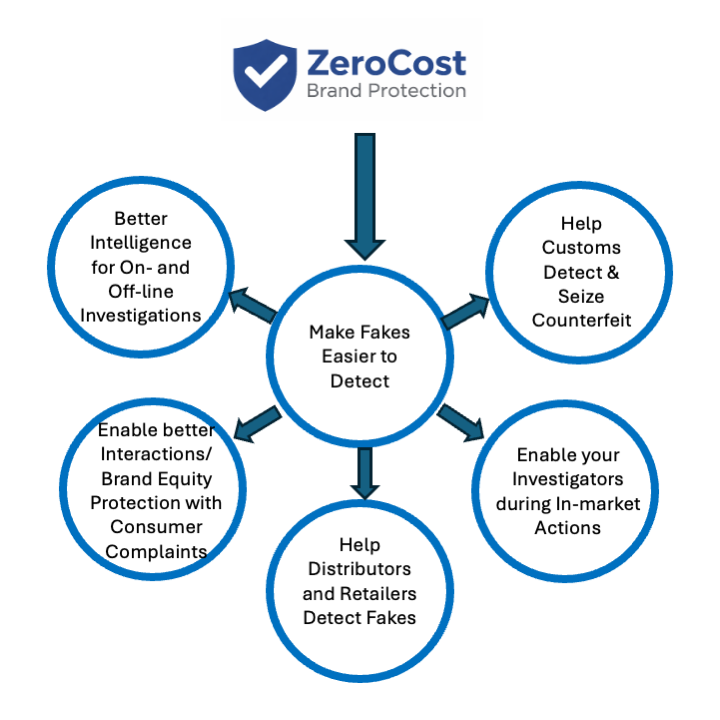
Crucially, not needing the physical product in front of you and having the ability to rapidly and accurately detect fakes from a photo enables you to rapidly respond to custom/ law enforcement who are searching shipments or locations anywhere in the world to enable counterfeits detection and seizure. It can help distributors, wholesalers and retailers not buy fakes from bad actors and organized gangs who sell counterfeit products.
The biggest loss to a company from counterfeiting is often the loss of Brand Equity when a consumer unknowingly buys a counterfeit and thinks your product is poor and not live up to it’s promises. Counterfeit detection by photo enables your Consumer Complaints department to better deal with consumers who have unknowingly bought a counterfeit and hence protect your Brand Equity.
It can also be the big “unlock” towards the improved monitoring of counterfeits, the size of the problem, on which brands, in which countries, and whether the problem is growing. This better knowledge of the “size of the prize” and location of the problem can guide more informed investment decisions, and crucially, support ongoing tracking of counterfeits. Is the problem getting worse or responding to good management?
Contact us
Interested in working together? Fill out some info and we will be in touch shortly. We can’t wait to hear from you!